

Airalo vs Nomad: Which eSIM is Better for Japan?
When planning a trip to Japan, choosing the right eSIM can make the difference between seamless connectivity and frustration. Two major contenders are Airalo Moshi Moshi eSIM and Nomad Japan Travel eSIM. I have tested both while travelling throughout Japan. In this head‑to‑head comparison, I summarise my personal experiences with each provider to help you decide which one suits your needs.
Both eSIMs run on SoftBank’s and KDDI’s mobile networks. They offer the convenience of buying eSIM plans online, activation immediately after landing, and avoiding overpriced roaming charges. However, they differ in pricing, plan options, setup process, network performance and extra features. Let’s dive into how Airalo and Nomad compare.
Note: Some links in this article are affiliate links. If you click on a link and purchase a service, I may earn a small commission at no extra cost to you. It helps me keep the blog running.
Overall ranking and pros & cons
Based on my experience, Airalo Moshi Moshi edges ahead for budget travellers who need a straightforward data-only plan. Nomad shines for travellers seeking flexible plan lengths or unlimited day passes and for those who want occasional 5G access. Below is an overview of the main advantages and disadvantages of each provider.
Airalo Moshi Moshi: Pros & Cons
- Pros
- Affordable pricing: 1 GB/7 days for $4.00 and 10 GB/30 days for $17, making it one of the cheapest options.
- Simple setup: purchase through the Airalo app or website; installation via app or QR code takes only minutes.
- Wide language and currency support: in the app and website, making checkout straightforward.
- Reliable coverage across Japan with seamless switching between SoftBank and KDDI networks.
- Easy top‑ups with app notifications when data runs low.
- Cons
- Limited to 4G/LTE: no 5G support.
- Data‑only: no voice or SMS services; you must keep your physical SIM for calls and texts, or buy Discover eSIM.
- More expensive unlimited day passes: with daily high‑speed quotas of 3 GB.
- Only 6 currencies supported
Nomad Japan Travel eSIM: Pros & Cons
- Pros
- Flexible plans: choose from fixed data (1 GB to 50 GB)
- Cheaper unlimited day passes: with daily high‑speed quotas of 2 GB.
- Supports 5G in major cities and offers fast 4G coverage nationwide.
- Easy installation with QR code or direct in‑app download.
- Reliable performance with consistent speeds (37.5 Mbps download in busy areas) and good streaming quality.
- Seamless top‑up options in the Nomad app; you can add data packages without losing service.
- Cons
- More expensive: 1 GB/7 days costs around $6 (≈£4.47) and unlimited 5‑day pass is about $16 (≈£12.82).
- Automatic activation 60 days after purchase means you shouldn’t buy too early.
- Data‑only: no voice or SMS.
- Limited language support
Price comparison
When comparing pricing, it’s important to use equivalent time frames and currencies. I used all prices to US dollars ($) for clarity.
| Plan & Provider | Data/Validity | Price (USD) | Notes |
|---|---|---|---|
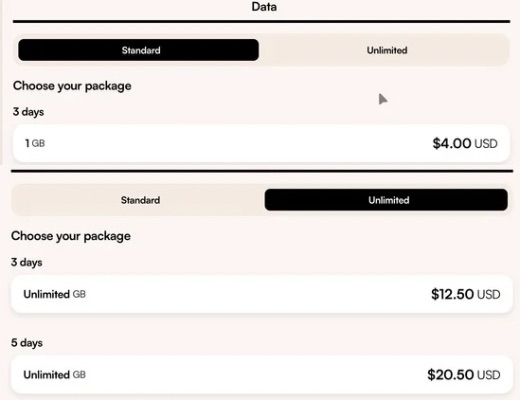
| Airalo Moshi Moshi | 1 GB for 7 days | $4.00 | Cheapest small plan; good for short trips. |
| Airalo Moshi Moshi | 5 day unlimited pass | $20.50 | 3 GB full speed, then throttled to 1Mbps. Slightly more expensive than Nomad. |
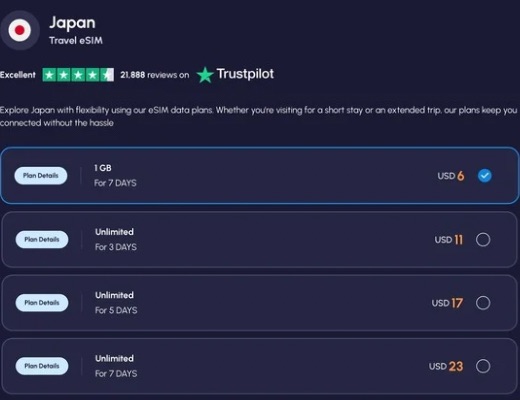
| Nomad Japan | 1 GB for 7 days | $6.00 | Slightly more expensive than Airalo. |
| Nomad Japan | 5 day unlimited pass | $17.00 | 2 GB full speed, then throttled to 1Mbps. |
Verdict
Airalo’s fixed‑data plans are cheaper than Nomad’s fixed plans, especially for small data needs. Nomad’s unlimited day passes are cheaper than Airalo’s; however, Airalo offers additional 1 GB per day in the full speed before applying throttling.
For travellers who need a few gigabytes for navigation and messaging, Airalo provides the best value. Heavy streamers or remote workers may lean towards Nomad’s unlimited passes.
Setup and installation
Airalo
Setting up Airalo is straightforward. I bought the plan through the Airalo website with 10% discount. After successful payment, I received an email with a QR code and instructions. Using stable Wi‑Fi at home, I opened the Android app. I followed the instructions on the screen and within seconds the eSIM profile was installed.
The entire process took about five minutes. Airalo supports multiple languages and but only six currencies. Several payment options are supported, so payment was effortless in the currency I wanted (£).
Savvy’s Tip: Install the eSIM before leaving for Japan and ensure your phone is eSIM compatible and unlocked .
Nomad
Nomad’s setup is similarly quick. I purchased the eSIM via Nomad’s website. The email I received included a QR code and manual installation instructions. On my Samsung Galaxy S22, I went to Settings → Connections → SIM manager → Add eSIM and scanned the code.
The eSIM profile appeared among other eSIM. I changed the label so I could easily distinguish different eSIMs. Nomad also offers an app that lets you install eSIMs without a QR code.
One caveat: Nomad eSIMs activate automatically 60 days after purchase, so avoid buying too early.
The entire process took about five minutes. Nomad supports less languages than Airalo, but supports more currencies. Several payment options are supported, so payment was effortless in the currency I wanted (£).
Verdict
Both providers make installation easy, but Airalo’s wider language support and currency options may be more user‑friendly for international travellers. Nomad’s automatic activation limit is a mild inconvenience if you plan far in advance. I personally don’t like eSIMs with automatic activation.
Network registration in Japan
Airalo
Upon landing at Haneda Airport, I disabled flight mode and the Airalo eSIM registered automatically on KDDI’s network within seconds. I did not see the “R” roaming indicator, meaning the eSIM behaves like a local SIM.
Throughout my trip from Tokyo to Sapporo and back, Airalo Moshi Moshi eSIM seamlessly switched between KDDI and SoftBank, always selecting the strongest signal .
Nomad
After switching off flight mode at Narita Airport, I enabled the Nomad eSIM and quickly connected to SoftBank. This time the phone showed “R” next to the signal bars, indicating roaming.
Despite the roaming symbol, I had immediate data access and could browse the web before leaving the airport. The eSIM automatically started my 7‑day validity period. In the rare case the eSIM doesn’t activate, Nomad’s email states you may need to tap an “Activate” button in the app .
Savvy’s Tip: Always check if you can see these arrows (top corner) going both directions. It means your phone is sending (arrow up) and also receiving (arrow down) data.
Verdict
Both eSIMs register quickly with no manual steps. Airalo behaves more like a local SIM (no roaming indicator), whereas Nomad shows the roaming symbol but functions equally well. The difference is cosmetic and doesn’t affect performance.
Reliability and user experience
Airalo
I used the Airalo Moshi Moshi eSIM for two weeks, travelling across Tokyo, Yokohama, Sapporo and Otaru. The connection was consistently reliable. I never lost signal even in underground stations. While speeds are limited to 4G, they were plenty fast for navigation, social media and video calls .
The eSIM switched seamlessly between networks, and the experience felt like using my regular data plan at home. The only drawback was the absence of 5G support .
Nomad
Nomad impressed me with reliability. I travelled from Tokyo to Kyoto and Okinawa, and the Nomad Japan eSIM provided consistent 4G and occasional 5G connectivity. I managed to watch YouTube videos on the bullet train, upload Instagram stories and even tether my Nintendo Switch for gaming without lag.
A speed test in Tokyo showed 37.5 Mbps download and 1.55 Mbps upload (see full review with the screenshot here), which is close to Japan’s average mobile speeds. Even though the phone displayed the roaming symbol, performance was on par with a local SIM.
Connectivity and speed
- Airalo: Only 4G/LTE but fast enough for streaming, video calls and navigation. In practice, I didn’t notice a difference compared to my home 5G network because the coverage was so consistent.
- Nomad: 4G/LTE with patches of 5G in major cities. Speed tests recorded 37.5 Mbps down and 1.55 Mbps up. Streaming and tethering were smooth even at this speed, making it suitable for heavy users.
Verdict
Both providers deliver excellent reliability. Airalo offers a stable 4G connection, while Nomad adds occasional 5G speeds. For most users, the difference isn’t huge. However, power users may appreciate Nomad’s extra speed.
If you want the fastest possible connection, choose Nomad. If you’re satisfied with reliable 4G, Airalo remains an excellent value.
Top‑up options
Airalo
Airalo makes managing your data straightforward. The app sends a notification when your plan is below 25% and allows you to purchase additional data with a few taps.
Top‑ups do not extend the existing plan’s expiry date. Instead, they create a new eSIM plan that runs concurrently. You can view remaining data and expiry dates on the app’s dashboard.
Nomad
Nomad offers flexible top‑ups within its app. If you run low on data, navigate to Manage → Japan eSIM → Add More Data. You can add 1 GB or 3 GB increments, and the cost matches the initial plan price. Like Airalo, each top‑up acts as a new plan and doesn’t extend the validity of your current one .
Verdict
Both apps make topping up easy. The difference lies mainly in pricing. Airalo add‑ons remain cheaper per GB.
Other features and considerations
- App experience: Airalo’s app supports numerous languages and a few currencies and provides push notifications for data usage and promotions. Nomad’s app is intuitive but offers limited language support but more currencies. It may be less accessible for non‑English speakers.
- Discount codes: Both providers offer promo codes. Airalo provides various discount codes (e.g., $3 off or 15% off). For Nomad, use my referral code LEOS92MM to get $3 off. There are occasional flash sales as well.
- Activation window: Airalo eSIMs have no auto‑activation limit; you can purchase months ahead. Nomad eSIMs must be activated within 60 days of purchase .
- Unlimited plans: Both offer unlimited eSIM plans. The difference is in the amount of data you can use with the full speed (Airalo 3GB, Nomad 2GB). Heavy users may prefer these despite the higher cost .
- Voice and SMS: Both providers are data‑only. If you need calls or texts, keep your physical SIM active or choose an eSIM that includes voice services (e.g. Airalo Discover eSIM).
Conclusion
Choosing between Airalo and Nomad depends on your priorities:
- Budget travellers and light data users should pick Airalo Moshi Moshi, which offers some of the cheapest per‑GB rates for Japan and a seamless setup experience. Its 4G speeds are more than adequate for navigation, messaging and streaming.
- Heavy data users or digital nomads who need unlimited day passes or occasional 5G speeds will appreciate Nomad’s flexible plans. However, be prepared to pay more and account for the 60‑day activation limit.
Overall, both eSIMs provide reliable connectivity across Japan. My recommendation is to choose Airalo for standard tourism and Nomad for high‑bandwidth activities. For additional comparisons and detailed reviews, check our related articles:
- Best eSIM for Japan guide – compares top providers including Airalo, Holafly and Nomad.
- Keep your phone number and use WhatsApp with eSIMs – a step-by-ste guide how to use your phone number while using WhatsApp with your travel eSIM
- Holafly Japan eSIM review – details unlimited plans and FUP.
- Nomad Japan travel eSIM review – examines fixed and unlimited day passes.
- Airalo Moshi Moshi review – outlines affordable fixed-data options.
- Ultimate eSIM guide – explains how eSIMs work and tips for installation.
Latest articles about eSIM in Japan:
- Airalo vs Nomad: Which eSIM is Better for Japan?

- Unlimited vs Fixed Data eSIM Plans: Which is Best for Japan?

- How to Keep Your Phone Number and Use WhatsApp in Japan

- Your 2025 Guide to Picking the Right Japan eSIM

- My Holafly Japan eSIM Review: Unlimited Data That Actually Work

- How to Stay Always Online in Japan: Nomad Japan Travel eSIM Review